
The lists disagree. The sand does not.
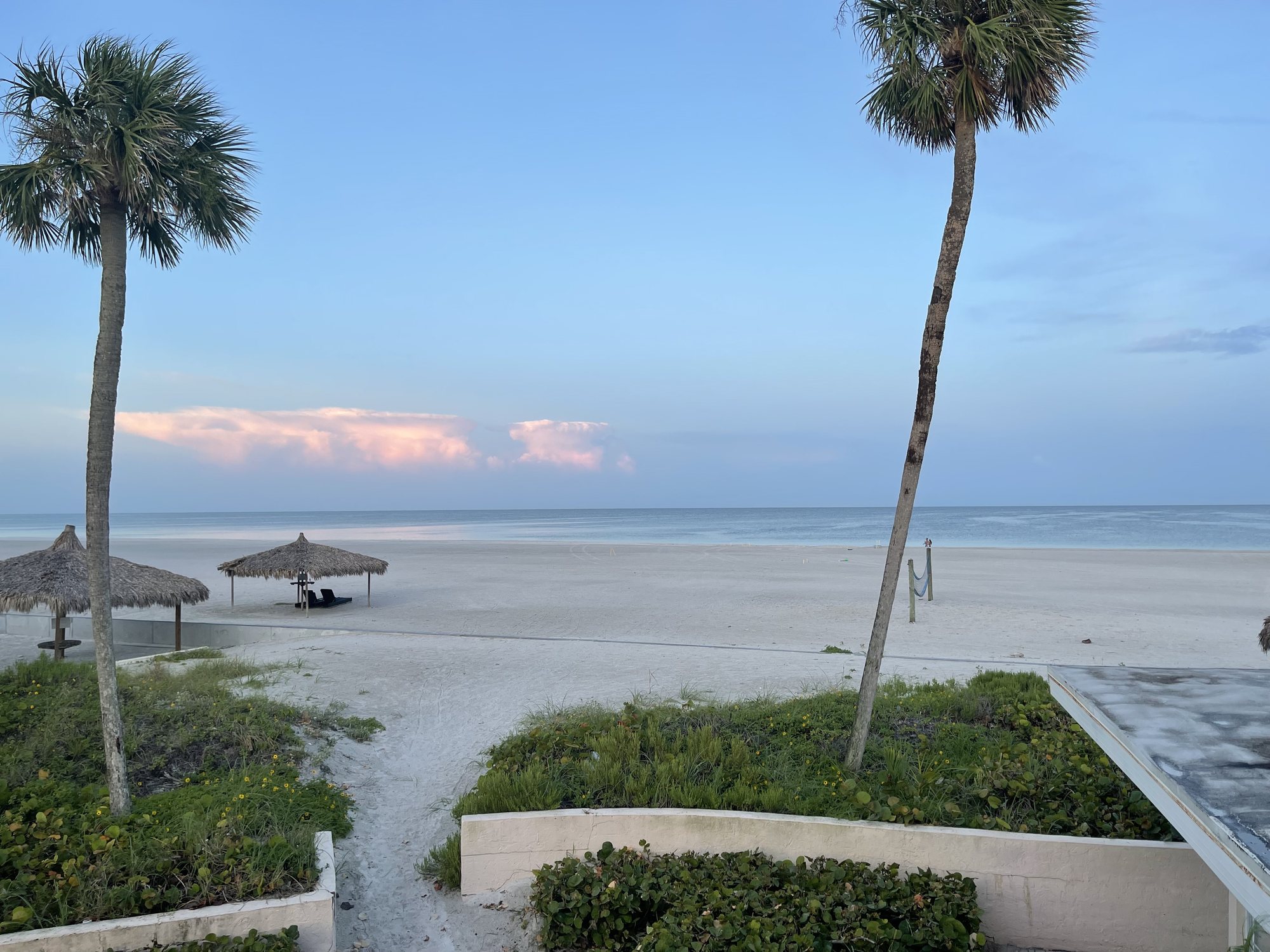
Walk the public beach at Siesta Key on a hard August afternoon and the physics feels wrong. The sand is white enough to make you squint. The Gulf sun is not shy. Your feet, somehow, are fine. That is not a branding slogan. It is mineralogy you can stand on.
The quartz under the pavilion did not grow here. A bronze marker at Siesta Public Beach, put up in 1986 by Sarasota County Parks and Recreation and the Sarasota County Historical Commission, says it plainly: the sand is mostly mineral quartz, ultimately derived from the southern Appalachian Mountains. Over millennia, the grains were carried by rivers into the Gulf and down the coast.
The U.S. Geological Survey tells the longer version. For much of its history the Florida Platform was a carbonate factory, limestone, shells, the stuff of coral seas. Then, beginning in the late Oligocene, rivers draining the southern Appalachians filled old seaways across north Florida and Georgia and spilled quartz-rich sand onto the platform. USGS scientists call it Florida’s siliciclastic “invasion.” It is still underway. Quartz continues to move south along peninsular beaches. “This process,” they wrote, “provided the State with the materials to create the high-quality beaches people enjoy today.”
Quartz is silicon dioxide. It rates 7 on the Mohs hardness scale. Diamond is 10. Softer companions in the original rock, feldspar, mica, weather into silt and wash away. What remains are tiny, stubborn grains of nearly identical size. Coastal scientist Stephen Leatherman, who publishes the annual “Dr. Beach” list from Florida International University, has called that size quartz’s “terminal” form: nature will not break it down, he has said, unless you put it on an anvil and hit it with a hammer.
Local officials have long described the public beach as unusually pure. In 2010, then–Sarasota County Parks general manager John McCarthy told the Herald-Tribune the sand is 99 percent quartz, exceptionally soft, and nearly free of shell. Sarasota County’s parks page still calls it nearly 100% quartz-crystal sand. U.S. News & World Report uses the same 99 percent figure in its Siesta Key guide.
White sand reflects more sunlight than darker, shell-heavy beaches, so it holds less heat. That is why barefoot August is possible here in a way it is not on black volcanic sand, or even on some of Siesta Key’s own shellier stretches to the south. County marketing sometimes says the sand never gets hot. That is too absolute. It runs cooler. It is not air-conditioned.
When the sand is dry, it can squeak. Leatherman has compared the sound to a finger on a crystal wine glass: well-sorted quartz grains, all roughly the same size, sliding in unison. Wet sand by the waterline goes quiet. That packed strip is where joggers and stroller wheels belong.
This is the property the lists keep citing. Leatherman named Siesta Beach America’s best in 2011 and again in 2017. Tripadvisor’s 2025 Travelers’ Choice awards put Siesta Beach No. 1 in the United States and No. 4 in the world. In 2026 the same list dropped it to No. 6 in the U.S. and still labeled it a quartz sand phenomenon. U.S. News, in April 2026, named Siesta Key the No. 1 U.S. beach destination. Condé Nast Traveler’s 2026 Readers’ Choice had it No. 8 among U.S. beaches. Dr. Beach’s 2026 top 10 did not include it at all. The lists disagree. The sand does not.
A note on names. The same quartz shoreline is Siesta Beach at the county park and Crescent Beach as you walk south toward Point of Rocks. Turtle Beach, farther south, is shellier. The county bought the public beach in 1954. The quartz did not care what anyone called it.
A 1987 tourism-industry white sand contest is still invoked locally as world’s finest, whitest sand. It was a judged publicity event, not a USGS assay. The geology does not need the trophy.
Stand at the waterline anyway. The barrier island under you is only a few thousand years old. The grains are vastly older, Appalachian rock, river-worn, Gulf-sorted, left behind because almost everything else gave up. That is the real inheritance at 948 Beach Road Directions. The rankings are a consequence.
Sources and further reading
From the journal
Related stories
Nature
The lot the storm took
Outer Cape
You come to the Outer Cape for this beach. What you find is a decision the storm already made.
Place
The hinge
Gulf Shores / Orange Beach
You pick Gulf Shores or Orange Beach as if those were two beaches.
Place
The postcard is not the swim
Santa Monica–Venice
You typed Santa Monica Beach and landed on the pier. That is the picture.