.jpg)
They are not a photo backdrop. They are not “wizard stones.”
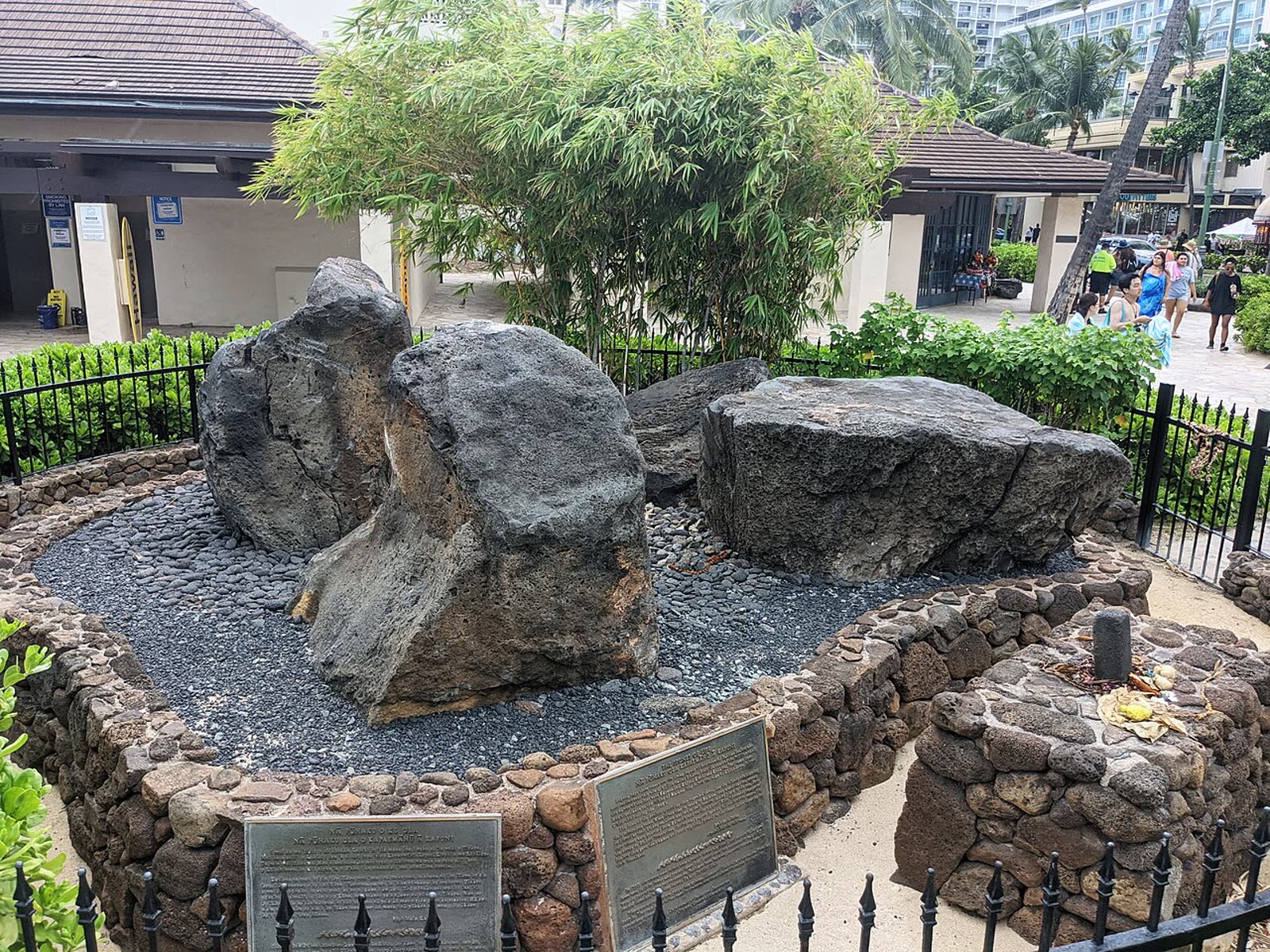
You will walk past them. Almost everyone does. Four dark boulders sit on a stone platform behind an iron fence at the western end of Kūhiō Beach Park Directions, Duke Kahanamoku’s statue on one side, the Waikīkī police substation on the other, Kalākaua moving past. People pose with Duke. The stones wait.
They are not a photo backdrop. They are not “wizard stones.” That English title was a 1907 choice for a haole almanac. The Hawaiian-language press advertised the same story as Ka Pōhaku Kahuna Kapaemahu, the healer stones of Kapaemahu. Kahuna here means expert. Not magician.
The moʻolelo, written down in 1906 and published the next year, says four healers came from Moaulanuiakea, remembered as Raiatea, long before the reign of Oʻahu chief Kakuhihewa. Their names were Kapaemahu, the leader, then Kapuni, Kinohi, and Kahaloa. They settled nearby at Ulukou, the kou-grove stretch now occupied by the Moana. They were māhū: people of dual male and female mind, heart, and spirit. James Aʻalapuna Harbottle Boyd, who conveyed the story, wrote that Hawaiians loved them for their “tall stature, courteous ways and kindly manners,” and that “their habits coincided with their womanly seeming, although manly in stature and general bearing.”
When they left, four stones were brought down from Kaimukī on the night of Kāne. Two were set at the healers’ residence, two at their bathing place in the sea. The healers transferred their names and mana into the pōhaku, then vanished.
That is the tradition. What happened next is the historical record, and it is uglier than any guidebook wants.
Princess Likelike and her daughter Kaʻiulani, sister and niece of Queen Liliʻuokalani, knew the stones on the family’s Waikīkī beachfront. They placed seaweed lei and offered prayer before entering the water. That reverence is why Archibald Scott Cleghorn, Likelike’s husband, had the four boulders excavated in 1905 and grouped in the yard. In his 1910 will he directed that the historical stones “shall not be defaced or removed” from the premises.
In 1941 a bowling alley went up anyway. The developer promised a setback. He buried the stones in the foundation instead. They stayed under Waikīkī Bowl for more than twenty years.
When the City tore the buildings down for a public beach park, the pōhaku came back up. Mary Kawena Pukui knew the story. She defined the name as “a row of mahu” and called the four “respected men; talented priests of healing and of the hula.” The 1963 plaque still said Wizard Stones. It did not say māhū. Parks embedded the boulders in the sand. People dried towels on them. They sat on them. They stacked surfboards on them.
In 1997, as part of an effort to restore Hawaiianness to Waikīkī, traditional healer Papa Henry Auwae led a restoration: platform, fence, medicinal plants, and a small stone brought from Raiatea. The City named the monument Nā Pōhaku Ola Kapaemāhū a Kapuni, Stones of Life, a title that does not appear in the 1907 record. The new plaques still left māhū off. A Waikīkī elder later put the silence plainly: everybody knew the healers were māhū, but you could never say that.
In October 2023 the City finally set a bronze plaque on a stone in front of the fence. It asks visitors to respect a cultural site of reverence, and it says what the older signs would not: these four healers from Tahiti were known for duality of male and female spirit, and for healing. Kumu Hinaleimoana Wong-Kalu, who is māhū, draped lei on the fence. She had already stopped at Boyd’s grave. “If not for his recordation of this,” she said, “we would not be able to tell this story today.”
So: do not sit on them. Do not drape a towel. Do not treat the enclosure as a luck shrine. Read the plaque. If you want more, the QR code goes to kapaemahu.info. Stand there long enough to understand that Waikīkī is not empty sand with hotels bolted on. These four stones outlasted a bowling alley, a restroom project, and a century of people who found māhū inconvenient. They are still here. That is the local story.
Sources and further reading
- kapaemahu.info — the site on the 2023 plaque’s QR code
- AP — Honolulu plaque names dual male and female spirit (Oct 2023)
- Kapaemahu history — Cleghorn, Waikīkī Bowl, restoration
From the journal